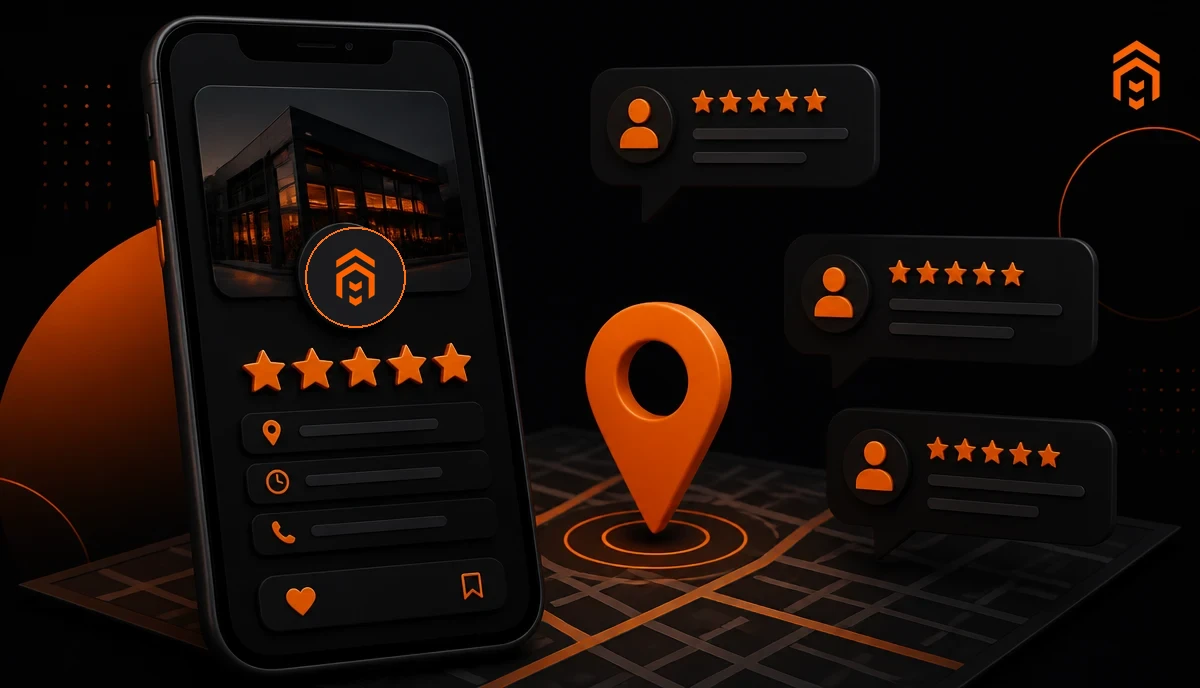
If you run a business in Egypt or the Gulf and you're not showing up on Google Maps, you're effectively invisible to more than half of your potential customers. Google Business Profile — formerly Google My Business — is the free listing that gets your company to appear on Google Maps and in the Local Pack that shows up alongside or above regular search results. This is the complete reference: from your very first setup step to a review strategy that puts you at #1 in your city. Written by Namra Tech based on real implementation across hundreds of websites and business profiles — our own profile carries a 5.0/5 rating on Google.
What exactly is a Google Business Profile? It's a free listing you control inside Google, containing your business name, category, address, coordinates, phone number, website, hours, photos, services, posts, Q&A, and — most importantly — customer reviews. This single listing feeds three surfaces at once: Google Maps, local search results, and Google's voice assistant. Any missing field is a lost visibility opportunity.
Why is it the most important free marketing asset you own? Because purchase intent in local search is about as high as it gets. Someone typing 'website design company in Mansoura' or 'accounting software in Riyadh' isn't browsing — they want to buy today. Your business profile puts you in front of them the moment they pick up the phone, with a direct call button, directions button, and message button, without them ever needing to visit your website. That's why we treat setting up the business profile as step zero in any SEO plan we build for a client.
The difference between organic ranking and Maps ranking: regular search results depend mainly on content, links and domain authority, while Maps results depend on three factors Google states explicitly: Relevance (how well your profile matches what the user is searching for), Distance (how geographically close you are to the searcher), and Prominence (how well-known your business is online — reviews are a core part of this third factor). The good news: two of the three factors are entirely within your control.
Step 1 — set up the listing correctly the first time: go to google.com/business with a Google account dedicated to the business (never your personal account), choose 'Manage now', and enter the business name. Golden rule: use the real trading name exactly as it appears on your sign and official documents, without stuffing in keywords. 'Namra Tech' is correct; 'Namra Tech — Best Website Design and ERP Company' is a clear violation that can get your listing suspended or auto-renamed.
Step 2 — choose the primary category (the single most important decision in the whole profile): the primary category is the strongest ranking signal on Google Maps. Choose the most specific category, not the broadest — 'Website Design Company' beats 'Computer Services', and 'Auto Parts Store' beats 'Store'. Then add up to 9 secondary categories covering your other services. Check the categories used by the top-ranking competitors in your city and compare them to yours — this gap alone explains most cases of poor visibility.
Step 3 — address and service area: if you have a physical location that receives customers, enter the full address and manually place the map pin exactly on your door. If you work remotely or visit the customer (software companies, maintenance, delivery), choose 'service-area business,' hide the address, and specify the cities and governorates you serve. Common mistake: entering a fake address or a PO box — a direct cause of permanent suspension.
Step 4 — verification: Google requires proof of ownership through one of several methods: a postcard mailed to your address with a 5-digit code (the most common method in Egypt, taking 5-14 days), a phone call or text message, an email on the company's domain, or a live video showing your sign, premises, equipment and your screen while logged in. Practical tip for the verification video: record one continuous take without cuts, starting from the street and sign, then the interior, then proof of management (a utility bill or commercial registration), then your phone screen while inside the listing.
Step 5 — fill in every field 100%: complete Google profiles get noticeably higher visibility. Fill in the description (750 characters explaining what you offer, for whom, and where, in natural language, no filler), business hours and public holidays, services with a price or price range for each, attributes (accepts electronic payment, available for online ordering, accessible), and your website link paired with a booking/quote link. Point the link to the relevant service page rather than always the homepage — for example the website design page or the online stores page.
Step 6 — photos and video: listings with real photos get significantly more direction requests and clicks than empty ones. Upload a clear square logo, a cover photo, exterior shots of the storefront from the street (helps customers actually find you), interior shots, team photos, and photos of completed work. Rule of thumb: authentic phone-camera photos beat perfect stock photos — Google detects images reused from elsewhere online. Add 3-5 new photos every month to keep the listing 'alive'.
Now the most important part — why Google Reviews are the new currency of trust: reviews influence two parallel tracks. The algorithmic track: review count, the speed they accumulate, average rating, and recency are all signals within the 'Prominence' factor that lifts your Maps ranking. The human, psychological track: the vast majority of users read reviews before any purchase decision and treat them as a personal recommendation. The result is that reviews don't just improve ranking — they raise the conversion rate from impression to phone call.
How many reviews do you need? There's no magic number. The practical rule: open Google Maps, search your target keyword in your city, and calculate the average review count of the top three results. Aim to beat that average by 20% within 90 days. Consistency matters more than raw count — 4 reviews a month for a year beats 50 reviews in one week followed by silence; a sudden spike is a suspicious pattern Google may remove.
The review-generation strategy we actually use: first, generate the short review link from inside the profile dashboard ('Ask for reviews') and save it. Second, turn it into a QR code and print it on invoices, cards, and a small counter stand. Third, ask for the review at the 'moment of satisfaction' — right after delivering the project or resolving an issue, not a month later. Fourth, send a short, personal WhatsApp message using the customer's name with the direct link. Fifth, train your team to ask verbally — a polite direct ask doubles the response rate. Sixth, naturally encourage customers to mention the service and city in their review — the review text itself is read algorithmically.
What you should never do: never buy reviews, never use fake accounts, never offer a discount or gift in exchange for a positive review (an explicit violation of Google's policy that can get all your reviews wiped at once), never collect reviews from a single device or network, and never use filtering gateways that block dissatisfied customers from leaving a review. Penalized listings don't just lose ranking — they lose years of accumulated trust.
How should you respond to reviews? A response is a positive signal to Google and a sign of professionalism to visitors. Respond to 100% of reviews within 24 hours. For a positive review: thank the customer by name, naturally mention the service they received ('glad our POS system helped your branch in Mansoura'), and invite them back. Avoid copy-pasted identical responses — repetition reads as automated.
A negative review is a marketing opportunity, not a catastrophe, if you follow a four-step formula: (1) a professional apology with no arguing, (2) show you understand the specifics of the case without disclosing private data, (3) explain the corrective action taken, (4) invite them to continue the conversation on a private channel with a clear number. Readers pay more attention to your response than to the complaint itself. If a review is genuinely fraudulent (abuse, a competitor, not an actual customer), flag it from the dashboard and request a review — but don't rely on removal as your primary plan.
Google Posts: an underused but powerful feature. Post weekly — an offer, news, a new project, or a short tip — with an image and an action button (Call Now / Learn More). Posts appear inside your listing in search results and boost engagement, which is itself a positive behavioral signal. Use them to promote pages on your site too, like pricing or our portfolio.
The Q&A section: anyone can ask a question on your listing — and anyone can answer it, including your competitor. Don't leave this section empty: post the 8-10 questions your customers actually ask (What are your prices? How long does delivery take? Do you serve outside the city? What payment methods do you accept?) and answer them fully yourself. These Q&As get indexed and can appear in search results — the same logic as the FAQ section on your website.
Consistency: the iron rule of NAP. Your business Name, Address and Phone number must be written identically, character for character, everywhere: the business profile, your website, Facebook, Instagram, LinkedIn, local directories, and even email signatures. Any discrepancy — an abbreviation versus the full word, an international versus local phone format — confuses Google's trust in your business identity and weakens your ranking. Also add LocalBusiness schema to your site with matching data to close the loop.
Connecting the profile to your website: the profile alone isn't enough to compete for harder keywords. Build a page on your site for every city you serve, each with genuinely different content (projects, prices, testimonials from that specific city), and link to them from the profile and from your posts. This is exactly what we build for clients as part of our local SEO service, and it's what turns Maps visibility into actual site visits and then leads.
Measuring results: from inside the profile, track five numbers monthly: search impressions versus Maps impressions, number of calls, number of direction requests, number of website clicks, and the actual queries your listing showed up for ('search queries'). That last number is a goldmine — use it to update your categories, services and articles. Tag the website link in your profile with UTM parameters so you can isolate profile traffic inside Google Analytics and see its real return.
A 30-day execution plan: Week 1 — create/reclaim the listing, complete verification, set the correct primary category and address. Week 2 — fill every field to 100%, upload 20 authentic photos, write the description and services with prices. Week 3 — launch your review campaign (link + QR code + WhatsApp messages to your last 30 customers), publish your first 3 posts, and seed 10 Q&A entries. Week 4 — unify your NAP data across every platform, add LocalBusiness schema, and review the numbers to adjust categories based on real search queries.
Bottom line: Google Business Profile isn't just 'a page on Google' — it's a complete sales channel that works 24 hours a day, and Google Reviews are the fuel that powers it. A fully completed profile, plus a steady flow of reviews, plus responding to every review, plus a fast website connected to real local content, adds up to sustainable #1 rankings that no one can simply buy with ads. If you'd like us to implement all of this for you — from setting up and verifying the profile to building city pages and a review-generation system — contact the Namra Tech team for a free audit of your business profile.